Supplement e-commerce SEO is one of the hardest verticals to crack on Google. The category sits at the intersection of three uniquely difficult problems: Amazon owns most product-name searches by default, the FDA limits what claims a supplement page can make, and Google's YMYL framework applies heightened quality scrutiny to anything that could affect human health.
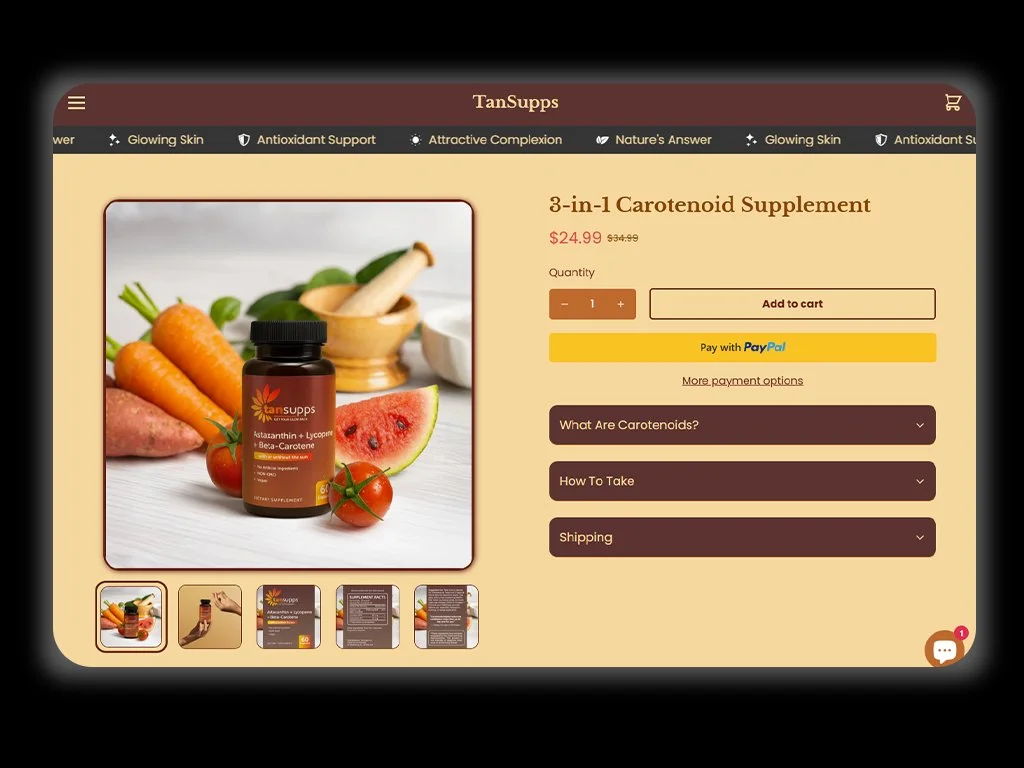
This is a working guide built around a real supplement category – carotenoid supplements like astaxanthin and beta-carotene that sit at the intersection of supplement and skincare search intent. The strategy here generalizes to any niche supplement brand: the constraints, the competitive landscape, and the playbook for ranking despite them.
The Three Structural Problems Supplement SEO Has To Solve
Before tactics, the constraints. Most supplement brands underperform in search not because their SEO is bad, but because they're trying to use generic e-commerce SEO tactics in a category where those tactics don't work.
Amazon owns commodity supplement searches. Search "vitamin C 1000mg" or "fish oil softgels" on Google in 2026 and the top half of the first page is Amazon listings, then Walmart, then iHerb, then maybe a brand site. For commodity supplements where the brand isn't a differentiator, an independent supplement brand simply cannot outrank Amazon on the product-name query. The strategy has to route around it – targeting brand-name searches, ingredient-education searches, and use-case searches instead.
FDA constraints limit what your pages can say. Supplements are regulated as a category of food, not as drugs, under the Dietary Supplement Health and Education Act. That means your pages cannot claim to "treat," "cure," "prevent," or "diagnose" any disease. The structured strategy is to use the FDA-permitted "structure/function" claim format – language about how an ingredient "supports," "maintains," or "promotes" a normal body function. The pages that rank in this category use this framing fluently. The pages that don't either say nothing (and look thin) or make claims that trigger FDA warning letters and remove the page from compliance.
YMYL scrutiny is real and measurable. Google's Search Quality Rater Guidelines explicitly call out supplement content as Your Money or Your Life territory – content where quality matters more because incorrect information could affect health decisions. The practical effect: thin product pages get filtered, anonymous content gets devalued, and content from sites without clear expertise signals struggles regardless of technical SEO. Author identification, citation density, and "About" page depth matter more here than they do for almost any other e-commerce category.
Where Niche Supplement Brands Actually Win
Given the constraints, the question isn't "how do I rank for vitamin C." It's "what queries can a niche supplement brand realistically win." Four categories produce most of the rankings.
Branded search. Searches for your specific brand name and your specific product line names. These are the easiest wins because there's no competition for your own brand – but they're only valuable in proportion to the brand awareness work you've done elsewhere (social, podcasts, press, paid). Branded search SEO is really brand-building SEO: make sure your site dominates your branded SERP, including knowledge panel, sitelinks, and any disambiguation Google might add. For supplement brands, this often means clean Organization schema with founder/author identification, FAQ schema for branded questions, and Review/AggregateRating schema where compliant.
Ingredient education searches. "What does astaxanthin do?" "Astaxanthin vs beta-carotene." "Is lutein safe long-term?" These are informational searches with substantial volume and remarkably low e-commerce competition because Amazon doesn't write educational content. A supplement brand with a working content strategy can dominate ingredient-education searches in 6-12 months and use those pages to introduce the brand to qualified researchers months before they're ready to buy.
Use-case and benefit searches. "Supplements for skin tone." "Best supplements for sun damage protection." "Natural supplements for healthy aging." These are mid-funnel queries – the searcher has identified a goal but not yet chosen a product. They have meaningful commercial intent (more than pure ingredient education) but also significantly less competition than direct product searches. The pages that rank here are usually round-up content with specific product recommendations – including yours.
Long-tail comparison and review queries. "[Your brand] vs [competitor brand]." "[Your product] reviews." "Is [your product] worth it." These come naturally as the brand grows. Capturing them requires structured comparison content (carefully written to avoid making competitor disparagement claims), review collection schema, and patient SEO work to outrank the affiliate and review sites that often own these terms.
Product Page SEO for Supplements: What Actually Matters
Most supplement product pages have one of three problems. Fixing any of them produces measurable ranking improvement; fixing all three is the difference between page 2 and page 1 in competitive supplement SERPs.
Ingredient depth. A page that lists "astaxanthin 12mg" as the active ingredient will lose to a page that explains what astaxanthin is, where the brand's astaxanthin is sourced from, the carotenoid family it belongs to, the difference between natural and synthetic astaxanthin, and what the dosage range in research literature looks like. This isn't padding – it's the genuine subject-matter depth Google's quality raters are explicitly trained to look for in YMYL content. A product page in this category should be 800-1,500 words of substantive content, not 200 words of marketing copy.
Author and credential signals. If a registered dietitian, MD, or other credentialed expert reviewed the content, say so explicitly with a byline, link to an "About the reviewer" page, and (where appropriate) schema markup naming the reviewer. Most supplement brands have access to credentialed reviewers but don't surface that on their product pages. Doing so is one of the highest-ROI signals you can add – it directly addresses the E-E-A-T (Experience, Expertise, Authoritativeness, Trustworthiness) factors that disproportionately affect YMYL rankings.
Product schema with the right properties. Supplements have specific Product schema properties most e-commerce platforms don't populate by default: nutrition, suitableForDiet, activeIngredient, and proper Brand association. Done correctly, these populate rich results – including nutritional information panels, dietary suitability badges, and product-specific knowledge graph entries that improve CTR even at the same position.
Content That Builds Topical Authority in Supplements
For niche supplement brands, content is the lever – not product pages. Content is how you escape Amazon's gravity, build E-E-A-T, capture early-funnel buyers, and turn ingredient-education traffic into branded search demand months later.
Ingredient deep-dives. One comprehensive page per active ingredient your brand uses. Treat each as the definitive resource for that ingredient: what it is, mechanism of action in plain language, dosage research, food sources, who shouldn't take it, common questions, related ingredients. These pages rank slowly but they rank deeply – and they support every product page that uses the ingredient.
Use-case comparison content. "Supplements for skin sun protection: a comparison." "How carotenoids compare to topical antioxidants." "Astaxanthin vs lutein for skin health." This is the content that captures mid-funnel buyers and routes them toward your products. Done correctly, it's not promotional – it's a genuine analysis that happens to include your brand among the comparison set.
Skincare-adjacent crossover content. For supplements that affect skin appearance – carotenoids being the cleanest example – there's enormous volume in skincare-context searches that supplement brands almost never target. "Foods rich in beta-carotene for skin." "Internal vs topical sun protection." "How long does it take to see skin benefits from supplements." Pages targeting these queries reach buyers who aren't searching the supplement category yet but will be after they read your content.
Technical SEO Issues Specific to Supplement E-Commerce
A few technical patterns matter more for supplement brands than for general e-commerce.
Variant management. Most supplement products come in multiple sizes (30-count, 60-count, 90-count), multiple subscription terms, and sometimes multiple flavors or formats. Without careful canonical handling, each variant URL competes with the others, splitting authority and confusing Google. Use one canonical product URL per SKU family with variants accessible via JavaScript selectors.
Review schema compliance. The FTC and FDA both pay attention to supplement reviews. Use Review and AggregateRating schema only when reviews are genuine, verified, and the AggregateRating reflects all reviews (not curated). Schema fraud in supplements draws regulatory attention faster than in most other categories.
International market segmentation. If you sell internationally, supplement regulations vary dramatically by country. Australia's TGA, the EU's Novel Food Regulation, and Canada's Natural Health Products framework all have different rules. Use proper hreflang tags to serve different versions of product pages to different markets – and make sure each version's content complies with that market's claim restrictions.
Site speed under high-detail product imagery. Supplement product photography is heavy: ingredient detail shots, lifestyle imagery, label close-ups, supplement-facts panels. Use modern image formats (WebP, AVIF), responsive image delivery, and a CDN that serves appropriately sized images per device. Slow-loading supplement pages are filtered hard in mobile-first indexing.
Supplement SEO is not e-commerce SEO with a health label. It's a distinct discipline with its own compliance constraints, its own quality bar, and its own competitive map. Brands that treat it as a specialized category – and build content, schema, and credibility signals accordingly – outrank larger competitors that treat supplements as just another product line.