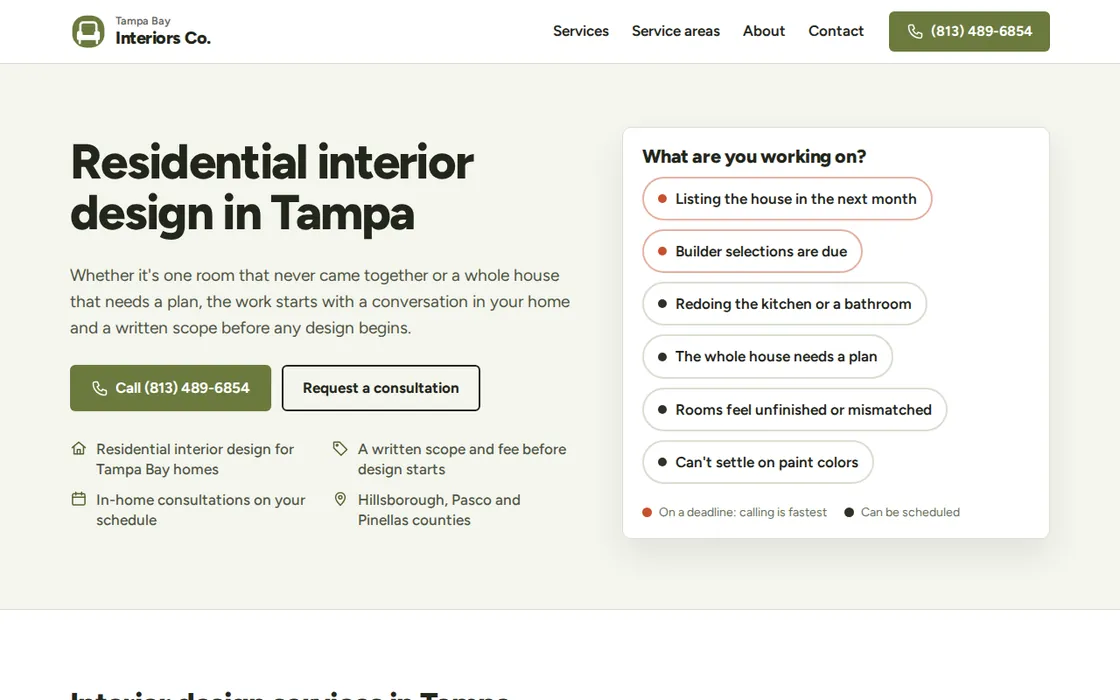
 My own interior design site. Live, ranking, taking leads.
Tampa Bay Interiors Co. is my own interior design lead site. I built it, I rank it, and real design inquiries come through it. Everything on this page, I learned there first.
The same four steps as any search, with the interior design details that change everything.
Or the kitchen is finally getting gutted, or the baby is coming and the spare room has to change. They open a phone and type “interior designer near me” or ask ChatGPT who does kitchens in their town.
Google shows three designers on the map and a few below it. ChatGPT names three or four. That is the whole list, and it was decided months ago by who had the pages, the photos and the reviews.
They tap through to the portfolio, look at four or five rooms, and book a consult with the one whose work looks like the home they want. They rarely scroll past the first few.
Not on the list? For that homeowner, your studio does not exist. The big remodel goes to a designer who ranked, or to the builder’s in-house team, and you never hear about it.
Getting on that list before the house closes, and staying on it, is the whole skill. It is what I do, on my own interior design site and for clients.
Type your city. I will open the three searches your customers use. If you are not on the first screen, that is the problem we fix.
Each one opens in a new tab. Look at the first screen only. That is all your customers look at.
Everything I know about ranking an interior design studio, in eight short reads. Each one is something I did on my own site first. New to all of this? Start with the Tampa SEO homepage, which explains how getting found works.
Most interior design clients are local. Here's how to make sure your firm shows up when people in your city search for a designer – in Google Maps and in.
Read the guide →02Targeting the right keywords is the difference between ranking on page one and ranking nowhere. Here's how interior designers build a keyword strategy that.
Read the guide →03Your portfolio is your best sales tool – and your most underutilized SEO asset. Here's how to optimize project pages to rank and attract the right clients.
Read the guide →04Most interior design websites are built for visual impact, not search visibility. Here's what on-page SEO actually looks like for a design firm – and what.
Read the guide →05Houzz is where most interior designers put their marketing energy. Here's an honest comparison of Houzz vs. SEO – and why the best studios use both.
Read the guide →06Most interior designer websites make the same SEO mistakes. Here's what's likely holding your site back – and what to fix first.
Read the guide →07SEO for interior designers takes time – but the results compound. Here's an honest month-by-month breakdown of what a well-executed SEO strategy looks like.
Read the guide →08Not every SEO agency understands the interior design industry. Here's what to look for, what to ask, and how to evaluate whether an agency is right for your.
Read the guide →
I use proven SEO strategies. My services are an investment, not an expense.
I grew up in Tampa. I got my finance degree at SMU in Dallas in 2021, then moved back home and started doing SEO for Mavilo Wholesalers.
My first big win was getting them to #1 on Google for engagement rings in Tampa. That felt amazing for both of us, and I have loved this work ever since.
In 2025 I finished my MBA and started my own company, Connor Cedro SEO LLC. I work alone on purpose. With the AI tools I have built, one expert can now do the work of a full agency team.
When I am not working, I am on the golf course with friends and family.
The Bay's construction and relocation wave fills whole neighborhoods with rooms to furnish. And their owners search styles before they search designers.
I took a Bay-area design studio from a standing zero to hundreds of monthly visitors. The exact portfolio-driven approach on this page, in this market.
Tampa's aesthetic searches are specific. “coastal living room,” “modern kitchen designer Tampa.” A project page per style owns each one.
Full technical audit to find what's keeping high-value clients from finding your firm.
Target how clients actually search. Firm type, project type, and location, like "residential architect [city]."
Fast, crawlable, mobile-clean pages. The plumbing that lets a portfolio actually rank.
Project pages, service pages, and guides written for how clients evaluate architects.
Citations and links from design, construction, and local publications that move rankings.
Every Tampa project published as a page that ranks. Style, room, and neighborhood, working permanently.
I review your technical health, rankings, backlinks, and competitors to find the biggest opportunities. The platform supports the audit; the judgment is mine.
A clear roadmap: keyword targets, project pages to build, technical fixes, and link strategy. In the order that moves revenue first.
Weekly work with plain-English reporting. You always know what was done, what moved, and what's next.
Plans start at $99 a week. No contracts. Cancel any time.
Every number I report comes from a tool you can log into yourself. Here is where each one lives, and what it actually proves.
| What we track | Where the number comes from | What it proves |
|---|---|---|
| VisibilityNumbers 1–4 | Semrush Authority Score, organic keywords, page-one keywords, referring domains. US database, checked monthly. | More searches find you. You show up for more of the things your customers type, and Google trusts the site more than it did. |
| TrafficNumber 5 | Google Search Console Clicks and impressions from Google, straight from Google. Not an estimate. | Real people are clicking. Rankings are nice. Visits are what rankings are for. |
| Leads | Your forms + Google Business Profile Form submissions, “Contact us” clicks and calls from your listing. Counted once per visit, spam and job applications removed. | They’re contacting you. This is the number the other four exist for. It sits at the top of your portal. |
| AI answers | Semrush AI Overview tracking Keywords where Google’s AI Overview cites your site as a source. | You’re in the answer, not under it. The new page one, measured the same way as the old one. |
| Revenue | You You tell me what closed. I match it to the page and the search it came from. | Which pages pay. That decides what I build next month. The one number I can’t pull myself, so I ask. |
What this can’t do: no one can guarantee a ranking, and no tool catches every phone call. The first four rows are Google and Semrush data. The last row is yours.
Coastal and modern-coastal searches are the Bay's design language. Project pages in those styles capture clients pre-decision.
Each install published, the space, the brief, the result, is how a studio here went from invisible to booked. Twenty projects beat a hundred posts.
Social resets daily; ranked project pages compound. The studio that owns Bay search stops depending on the algorithm's mood.
Seven checks you can do yourself in five minutes, before you pay anyone for SEO. Including me. Tap each one to see how.
Type your business name into Google. You should be the first result, with your listing on the right. If a directory or a competitor shows up above you, that is problem one.
“Plumber Tampa.” “Jeweler Tampa.” Look only at the first screen. Are you there? Write down who is. Those are the names taking your calls.
Maps shows three pins. Most people call one of those three. If you are not one of them, you are invisible to anyone searching from their phone.
“Who is the best [what you do] in [your city]?” Read the short list it gives. This is the newest place people look, and most businesses have never checked it.
Claimed by you, right hours, real photos, a reply under every review. An unclaimed or half-empty listing is the fastest fix on this list.
Count to three. Did it load? Can you tap to call from the first screen? If either answer is no, Google notices too.
“Who actually does the work?” and “What will I see each month?” If the first answer is not a name, or the second is not numbers you can check yourself, walk away. That includes me.
Want me to run all seven for you? Book a free call →
I can answer from this exact market. A Bay-area studio went from zero organic presence to hundreds of monthly visitors on this playbook. The lane is open.
Style + room combinations, “interior designer Tampa/St. Pete,” and project-type searches. The portfolio, published properly, covers most of it.
It floods the market with owners searching styles for brand-new rooms. Design demand with no incumbent designer attached.
Local designer terms often move in 2 to 3 months; each published project compounds the set.
No. Everything is week to week, and every engagement starts with a free 30-minute call so you can see the opportunity before spending anything.
I do. You work with me directly. No account managers, no outsourcing. That's the entire model.
Don't see your question? Book My SEO Consultation and I'll answer it directly.
I’ll make sure you show up everywhere, from Google to ChatGPT.